If your child came home from school talking about “core competencies”, “learning indicators” or “the 4Rs”, you have met the standards-based curriculum. It replaced the old objective-based syllabus and changed not only what Ghanaian children learn, but how they are taught and how they are assessed.
Many parents have never had it explained properly. This article does that, in plain language: what the curriculum is, what changed at KG, primary and JHS, how your child is now assessed, what is happening with the proposed revision in 2026, and what it all means for you at home.
What Is the Standards-Based Curriculum?
The standards-based curriculum was developed by the National Council for Curriculum and Assessment and rolled out by the Ghana Education Service from the 2019/2020 academic year, replacing the KG to Primary Six curriculum that came before it.
The older curriculum was built around objectives: things a teacher should cover. The standards-based curriculum is built around standards: things a learner should actually be able to do by the end of a phase. That sounds like a small difference. In the classroom it is not. It shifts the question from “did the teacher teach it?” to “can the child do it?”
The Big Changes at KG
Kindergarten saw the most dramatic change. KG subjects were reduced from seven to four, grouped into themes rather than taught as separate subjects:
- Numeracy
- Literacy
- Creative Arts
- Our World, Our People (citizenship and the child’s environment)
The reasoning was straightforward. Four and five year olds learn best through depth and play, not through shallow coverage of seven separate subjects. Fewer themes allow teachers to spend longer on language and number, which are the foundations everything else rests on.
If you are still deciding which early years class your child belongs in, our guide on crèche, nursery and KG in Ghana walks through each stage.
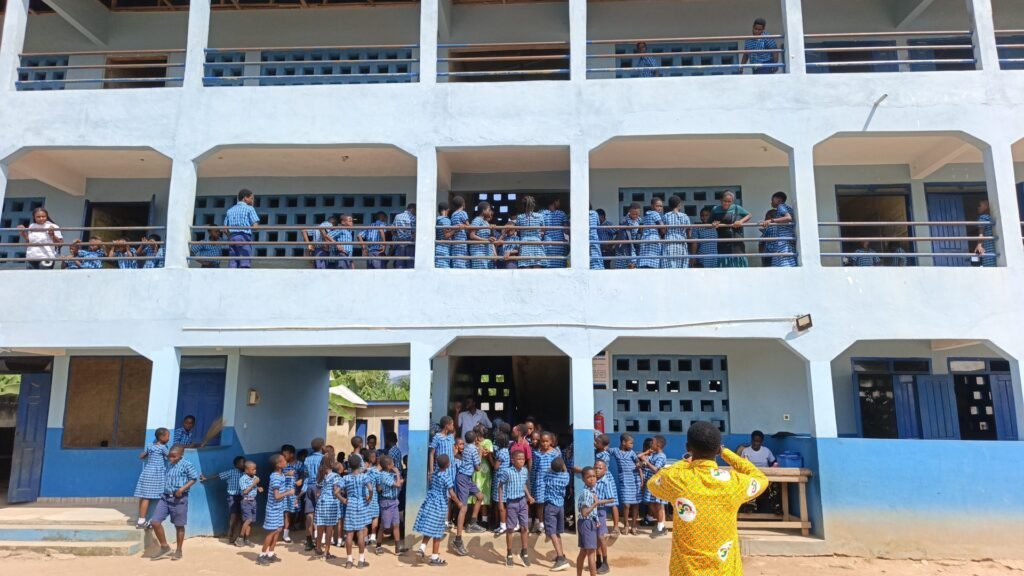
The Big Changes at Primary
At primary level the number of subjects stayed broadly the same, but the content shifted in four notable ways:
History of Ghana became compulsory
From Class 1 to Class 6, History of Ghana is now a standalone compulsory subject. Previously, Ghanaian history was buried inside Social Studies and often skipped. The intention is to build national identity and historical literacy from an early age.
Religious and Moral Education became a separate subject
RME was restored as a distinct subject rather than being absorbed into other learning areas.
Physical Education became practical
PE is now meant to be taught practically rather than theoretically. In honest terms, this is the area where schools vary most. A school where PE exists only on the timetable is not delivering the curriculum.
French was introduced in upper primary
French now appears from upper primary, reflecting Ghana’s position among francophone neighbours.
The 4Rs and the Core Competencies
Two ideas sit at the centre of the curriculum. The first is the 4Rs: Reading, wRiting, aRithmetic and cReativity. The addition of creativity to the traditional three was deliberate, and it is why you will see more project work, group tasks and presentation than your own schooling probably involved.
The second is a set of core competencies the curriculum aims to build across every subject: critical thinking and problem solving, creativity and innovation, communication and collaboration, digital literacy, personal development and leadership, and cultural identity and global citizenship.
The shift is from a child who can recall to a child who can reason. Recall still matters. It is simply no longer the whole point.
How Assessment Changed
This is the part parents notice first. Under the standards-based curriculum, assessment is continuous rather than concentrated entirely in end-of-term examinations. Teachers assess through class exercises, projects, observation and oral work as well as written tests.
National assessments were also introduced at Primary 2, Primary 4 and Primary 6, to check literacy and numeracy standards across the system rather than to grade individual children for placement. These are diagnostic. They tell the school, and the country, where children are falling behind while there is still time to fix it.
At the end of JHS 3, the BECE remains the terminal examination that determines senior high school placement. Our BECE preparation guide covers that stage in detail.
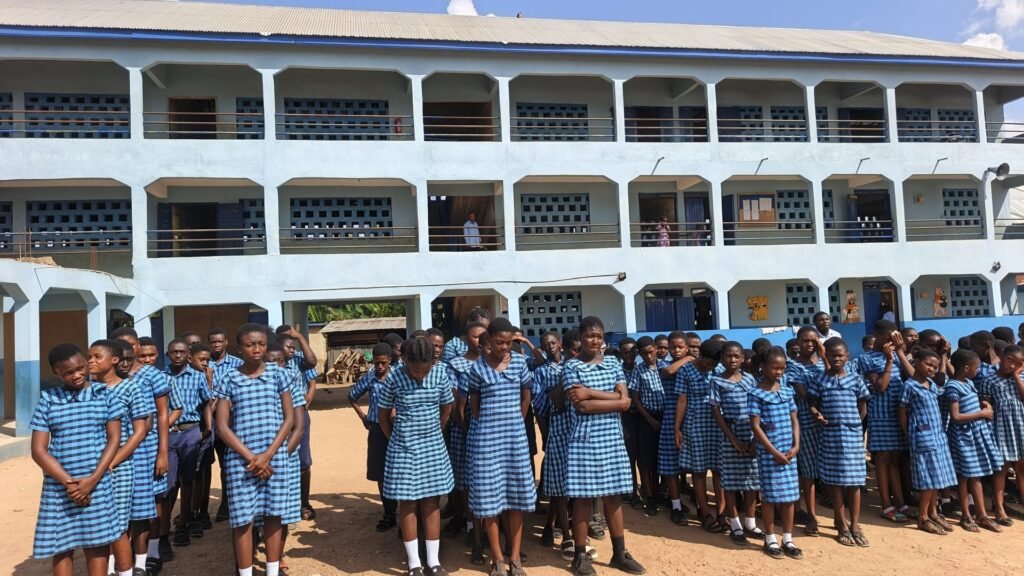
What Is Happening With the Revised Curriculum in 2026?
There has been a lot of confusion on this point, so it is worth stating clearly. As of August 2026, the Government had not yet formally adopted a revised KG to Primary Six curriculum.
The National Council for Curriculum and Assessment developed a revised version and submitted it to the Minister of Education. The Ghana Education Service is reviewing it. After that review it goes to Cabinet for approval, and only then to the Ministry of Education for formal adoption.
The Minister for Education has described the aim as repositioning basic education to make Ghanaian children globally competitive, with greater emphasis on moral values, problem solving and critical thinking, and with artificial intelligence, robotics, STEM and digital learning introduced at the foundation level.
What this means practically for parents: the standards-based curriculum your child is learning under remains in force. If and when the revision is adopted, schools will be formally notified and materials will follow. Be sceptical of anyone selling you “the new curriculum textbooks” before an official adoption is announced.
What This Means for You at Home
The curriculum asks more of parents than the old one did, in a good way. Three things help most:
Ask about the doing, not just the marks. Instead of “what did you score?”, try “what did you make today?” or “what did your group work on?” Project work is now part of assessment, and children who talk about their learning retain more of it.
Take continuous assessment seriously from term one. Under the old system a child could coast and then cram. Under continuous assessment, a weak first term is harder to recover from because it is already counted.
Support reading above everything. Every core competency, including the digital and creative ones, runs through reading. A child who reads fluently can teach themselves almost anything else.
How We Teach the Curriculum at Oyoko New Life School
At Oyoko New Life School we follow the Ghana Education Service curriculum and academic calendar across every stage, from crèche and KG through primary to JHS 3. Our teachers are trained and certified, our schemes of work follow NaCCA guidance, and we take the practical subjects, Creative Arts, Physical Education and Computing, as seriously as the written ones, because the curriculum intends them to be taught, not listed.
You can read more about our school or see our classrooms in the gallery.
What the Curriculum Looks Like at JHS
At junior high school the standards-based approach continues, but the stakes change because the BECE sits at the end of JHS 3. Learners study English Language, Mathematics, Integrated Science, Social Studies, Religious and Moral Education, a Ghanaian Language, Computing, and Career Technology or Creative Arts and Design.
The emphasis on application rather than recall is particularly visible in Mathematics and Integrated Science, where questions increasingly ask learners to use a concept in an unfamiliar situation rather than reproduce a definition. Parents sometimes read this as the papers becoming “harder”. In reality they are testing understanding rather than memory, which rewards children who were taught properly from Class 1.
Four Common Misunderstandings
“Fewer KG subjects means children learn less”
The opposite is intended. Four broad themes allow more time on language and number, which are the foundations everything else depends on. Coverage was reduced so that depth could increase.
“Continuous assessment means examinations do not matter”
Examinations still matter a great deal, particularly the BECE. Continuous assessment simply means the rest of the year counts too, so a weak first term is harder to erase.
“Creativity means less academic rigour”
Creativity in the 4Rs means applying knowledge in new ways. It sits alongside reading, writing and arithmetic rather than replacing any of them.
“History of Ghana is optional”
It is compulsory from Class 1 to Class 6. If your child’s school is not teaching it, the school is not following the curriculum.
Questions Worth Asking Your Child’s Teacher
If you want a genuine picture of how your child is progressing under this curriculum, these questions work better than “is he doing well?”:
- Which learning indicators is my child not yet meeting at this level?
- How is continuous assessment contributing to the report grade?
- What project work is planned this term, and how can we support it at home?
- Is my child reading at the expected level for this class?
- Which of the core competencies does my child find most difficult?
Teachers respond well to specific questions, because they can give specific answers. Vague questions invite polite reassurance that helps nobody.
Frequently Asked Questions
What is the standards-based curriculum in Ghana?
It is the curriculum introduced by the Ghana Education Service from the 2019/2020 academic year, developed by NaCCA, which defines what learners should be able to do at each phase rather than simply what teachers should cover.
How many subjects are taught at KG under the curriculum?
Four learning areas: Numeracy, Literacy, Creative Arts, and Our World, Our People. This replaced the previous seven subjects.
Is History of Ghana compulsory in primary school?
Yes. History of Ghana is a compulsory standalone subject from Class 1 to Class 6.
Has Ghana adopted a new basic school curriculum in 2026?
Not yet. As of August 2026 a revised KG to Primary Six curriculum had been developed by NaCCA and was under review by the Ghana Education Service, awaiting Cabinet approval and formal adoption.
What are the 4Rs?
Reading, wRiting, aRithmetic and cReativity, the four foundational skills the curriculum is built around.
Talk to Us About Your Child’s Learning
If you would like to understand how the curriculum is taught at your child’s level, come and speak with our teachers.