Choosing a basic school is one of the heaviest decisions a parent makes, and in and around Koforidua there is no shortage of options. Signboards promise excellence on almost every street. Some schools genuinely deliver it. Others are running on reputation, a smart uniform and a well-painted wall.
This guide gives you ten practical things to check before you commit your child to a school, whether you are looking in Koforidua town, Oyoko, Effiduase, Asokore or anywhere else in the New Juaben Municipal. None of them require you to be an education expert. All of them can be checked in a single visit.
1. Visit on a Normal School Day, Unannounced
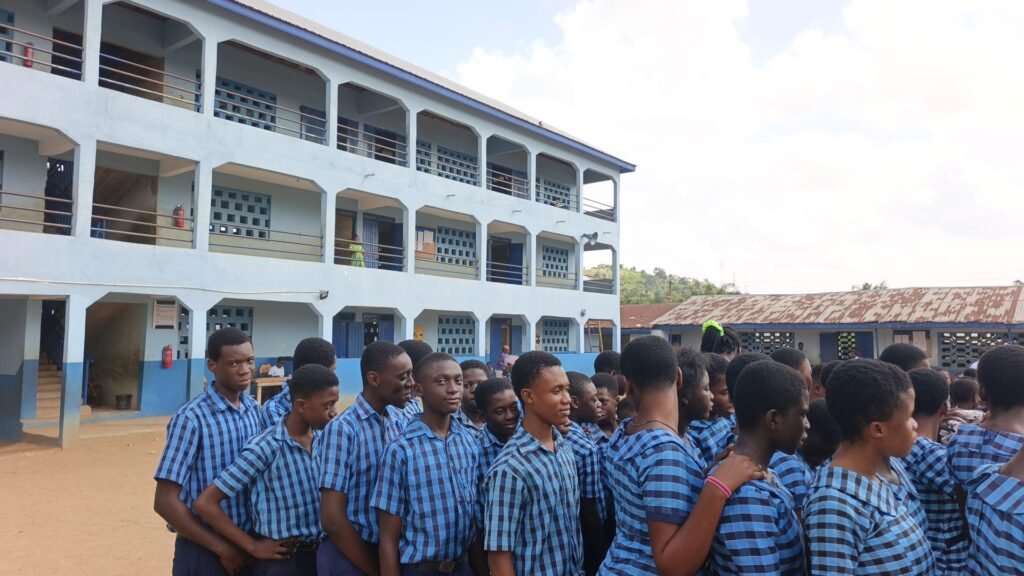
This is the single most useful thing you can do. A scheduled visit shows you a performance. An ordinary Tuesday morning shows you the school. Are classes actually running? Are teachers in their classrooms? Are children engaged, or wandering? Is the compound clean before anyone knew you were coming?
Any good school will be happy to let you look around. A school that insists on appointments weeks ahead, or steers you away from classrooms, is telling you something.
2. Ask About Teacher Qualifications and Turnover
Ask two questions. First, how many teachers are trained and certified? Second, how many teachers left at the end of last academic year?
The second question is the revealing one. High teacher turnover is the most reliable warning sign in Ghanaian private education. Children lose continuity, teaching standards drop, and the school is usually either underpaying or badly managed. A school where most teachers have been there three years or more is doing something right.
3. Look at Class Sizes, Not Just Facilities
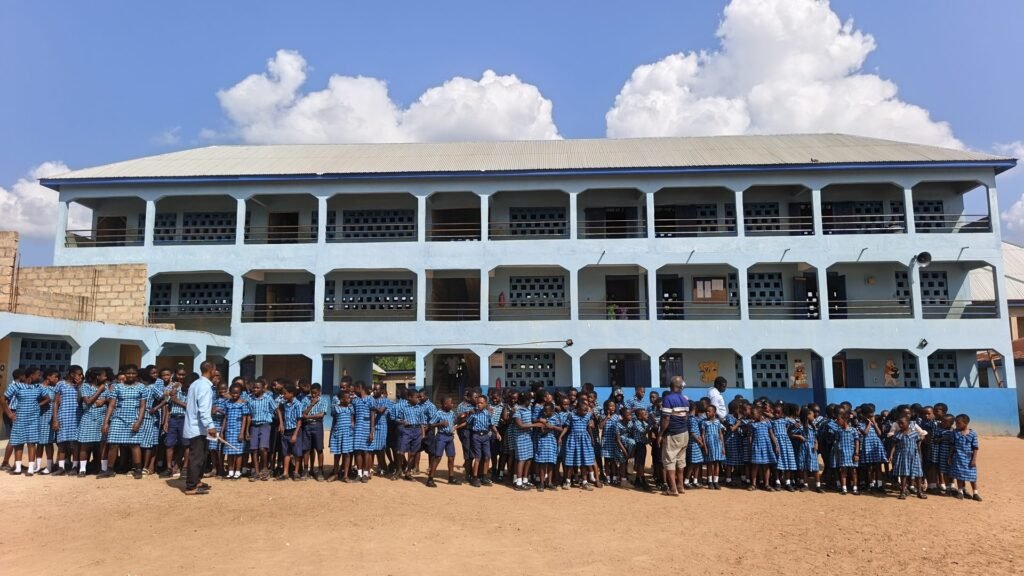
A beautiful three-storey block means nothing if there are sixty children in a class. Ask the actual number per class at the level your child will join, and ask to see the register rather than accepting a general figure.
For early years, smaller is dramatically better. For upper primary and JHS, a class in the thirties is workable if the teacher is strong, but beyond forty, individual attention becomes almost impossible.
4. Check That the School Follows the GES Curriculum Properly
Every basic school in Ghana should be teaching the Ghana Education Service standards-based curriculum, including History of Ghana as a compulsory subject from Class 1 to Class 6, Religious and Moral Education, Physical Education taught practically, and French in upper primary.
Ask to see a scheme of work and a weekly timetable. If a school cannot produce either, it is improvising. If Physical Education, Creative Arts and Computing exist only on the timetable and never in practice, your child is getting a narrower education than the curriculum intends.
5. Ask for BECE Results, in Detail
Schools love to quote a pass rate. Press further. Ask how many candidates sat the BECE last year, how many were placed in senior high school, and what the range of aggregates looked like.
A school with twenty candidates and five excellent results is a very different place from a school with twenty candidates and twenty solid ones. And given that around 50,000 candidates nationally missed placement for the 2026 academic year because they failed English or Mathematics, a school’s record in those two subjects specifically is worth asking about.
Our guide to BECE preparation in Ghana explains why those two papers carry so much weight.
6. Walk to the Toilets and the Water Point
It is not a glamorous check, but it is one of the most honest. Clean, working, separated toilets and a reliable source of drinking water tell you how seriously a school takes the daily welfare of children. Parents rarely inspect these. Schools know it.
7. Understand the Full Cost, Not Just the Fees
Ask for a written breakdown covering tuition, admission fee, examination fees, uniform, sportswear, books and stationery, PTA dues, feeding if applicable, and transport if you need it. Then ask the question that matters most: how often have fees increased in the last three years, and by how much?
A school that is transparent about cost is usually transparent about other things too. Surprise charges mid-term are a management problem, not an accounting one.
8. Observe How Discipline Is Handled
Ask directly what the school does when a child misbehaves, and listen carefully to the answer. You are looking for a school with a clear, consistent policy, communication with parents, and consequences that are proportionate. Corporal punishment is not permitted in Ghanaian schools, and a school that is casual about it is casual about other rules too.
Equally, a school with no visible structure, where children do as they please, is not kind. Children need predictable boundaries to feel secure.
9. Ask How the School Communicates With Parents
How often are reports issued? Are there PTA meetings, and how well attended are they? Is there a phone number that is actually answered? Will you hear from the school if your child is struggling in term one, or will you discover it on the end-of-year report?
The best schools contact parents before problems become crises. That habit, more than any facility, is what protects a child’s progress.
10. Think About the Whole Journey, Not Just Next Year
Changing schools is disruptive. Every move costs a child time, friendships and confidence. If a school runs from crèche through to JHS 3, your child can complete the entire basic education journey in one place, taught by people who have known them for years.
Also ask about what is coming. A school that is investing, adding facilities, planning boarding, improving its blocks, is a school with a future. One that has not changed in a decade may be comfortable rather than ambitious.
A Simple Checklist to Take With You
- Did I visit unannounced on a normal school day?
- How many teachers are trained, and how many left last year?
- How many children are in the class my child would join?
- Did I see a scheme of work and a timetable?
- What were last year’s BECE results, in detail?
- Are the toilets clean and is there drinking water?
- Do I have the full cost in writing?
- What is the discipline policy?
- How and how often will the school contact me?
- Can my child stay here from early years to JHS 3?
About Oyoko New Life School
Oyoko New Life School is a basic school 4km north of Koforidua in the New Juaben Municipal, Eastern Region. We teach from crèche right through to JHS 3 on one campus, follow the Ghana Education Service curriculum and academic calendar, and employ qualified, trained teachers in every department. Boarding facilities are coming soon. Our motto, Education is the Key, is not decoration; it is how we make decisions.
You are welcome to see the school for yourself. Browse our photo gallery, read more about our school, or come and visit.
Red Flags That Should Make You Walk Away
Most schools have minor weaknesses, and a school with one problem is not necessarily a bad school. But some signs are serious enough that you should keep looking:
- You are not allowed to see classrooms. There is no legitimate reason to keep a prospective parent out of a classroom during teaching hours.
- Nobody can tell you how many teachers left last year. Either they do not know, which is poor management, or they would rather not say.
- Fees change without notice. Mid-term charges that were never mentioned are a sign of cash-flow trouble, and cash-flow trouble becomes unpaid teachers.
- Teachers are frequently absent and classes merged. Merging two classes “for today” occasionally is normal. Doing it weekly is not.
- No written records. No scheme of work, no attendance register you can see, no report template.
- The head is evasive about BECE results. A school proud of its results will show them to you.
- Children look fearful rather than relaxed. Trust your instinct on this one. You will feel it within ten minutes.
Talk to Parents Who Already Use the School
Brochures and signboards tell you what a school wants you to believe. Current parents tell you what actually happens. Stand near the school gate at closing time and ask two or three parents a few direct questions:
- How quickly does the school respond when you call about a problem?
- Has your child’s class had the same teacher all year?
- Were there any charges you did not expect?
- Would you choose this school again?
That last question is the most revealing one you can ask. Parents answer it honestly, and they answer it fast.
Match the School to Your Own Child
Finally, remember that the best school in the district is not automatically the best school for your child. A quiet, anxious child may thrive in a smaller school with close supervision and struggle in a large, competitive one. A confident, easily bored child may need the pace and pressure that a larger school provides.
Think about your child’s temperament, the subjects they love, how far they can realistically travel each day, and how much support you can give at home. A school that fits is worth more than a school with a reputation.
Frequently Asked Questions
What should I look for when choosing a basic school in Ghana?
Visit unannounced, check teacher qualifications and turnover, confirm class sizes, verify that the GES curriculum is being taught, ask for detailed BECE results, inspect sanitation, get the full cost in writing, and understand the discipline and communication policies.
How important are BECE results when choosing a school?
Very, but only when examined in detail. Ask how many candidates sat, how many were placed, and how the school performs specifically in English Language and Mathematics.
Is a private school always better than a public school in Ghana?
No. There are excellent public schools and weak private ones. Judge the individual school on teaching quality, class size, teacher retention and results, not on the category it belongs to.
Should my child stay in one school from KG to JHS?
Where possible, yes. Continuity protects a child’s confidence and allows teachers to build a long-term understanding of their strengths and weaknesses.
Come and See for Yourself
If you are considering a school for your child in the Koforidua area, we would be glad to show you around on an ordinary school day.
Start an admission application or contact us on +233 24 984 4530.